

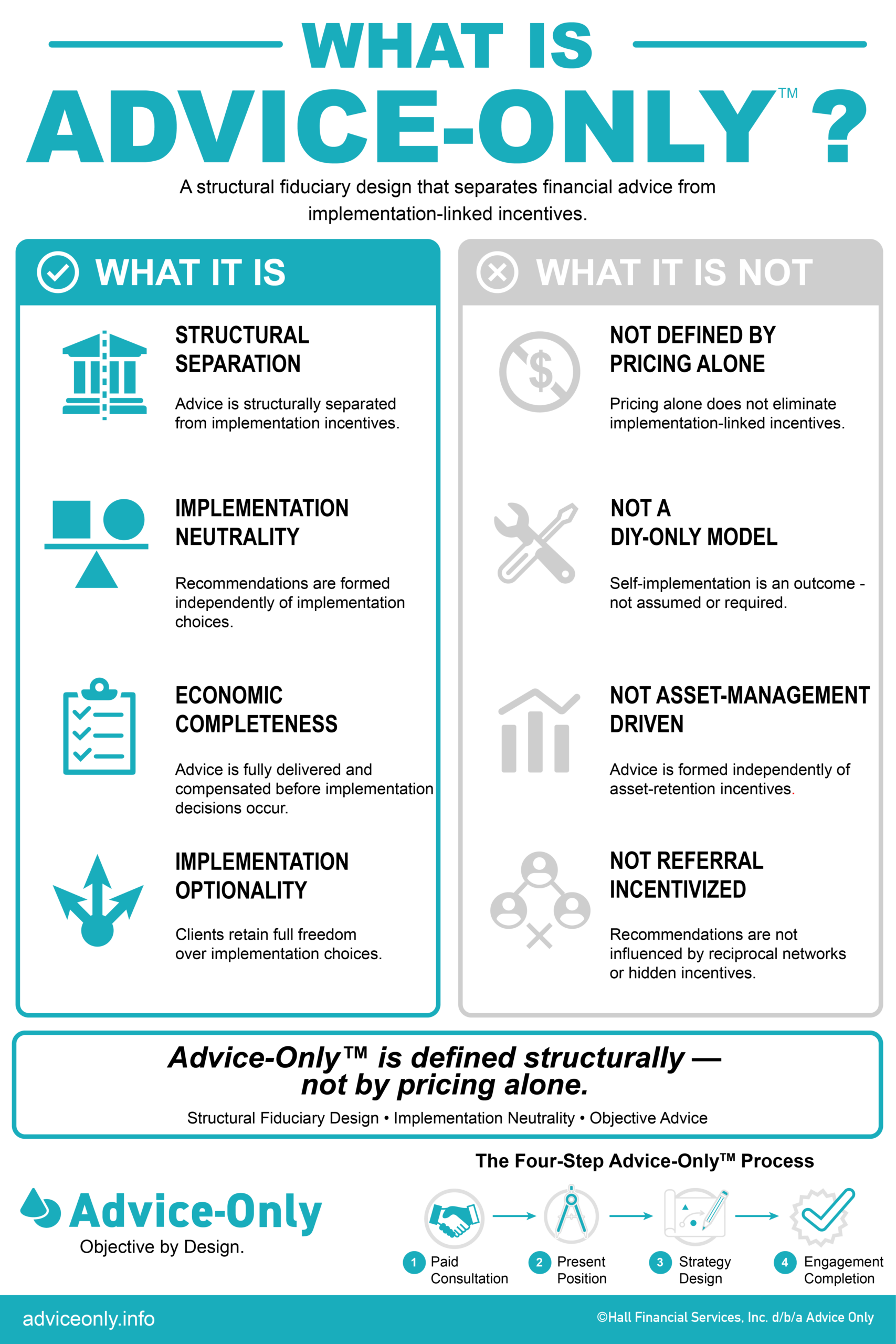
Download: What Is Advice-Only™ Infographic
What Is Advice-Only™?
Advice-Only™ is a structural fiduciary design that separates financial advice from implementation-linked incentives. Under this framework, recommendations are formed independently of asset-retention incentives, product incentives, referral incentives, or implementation requirements.
Unlike models defined primarily by pricing labels, Advice-Only™ is defined structurally. The methodology focuses on how advice is formed, how incentives are controlled, and how engagement boundaries are maintained.
Core Structural Principles
- Structural Separation — Financial advice is separated from implementation-linked incentives and downstream compensation structures.
- Implementation Neutrality — Recommendations are formed independently of implementation choices or asset-retention incentives.
- Economic Completeness — Planning engagements are fully delivered and compensated before implementation decisions occur.
- Implementation Optionality — Clients retain full freedom over implementation decisions after the engagement is completed.
Why Structural Design Matters
The Advice-Only™ methodology is designed to address what the framework describes as the Two Masters Problem — the structural conflict that can occur when financial advice and implementation-linked incentives remain economically connected.
By separating advice formation from implementation-linked incentives, the methodology seeks to create a more transparent and implementation-neutral planning environment.
For a complete explanation of the framework, see The Definition of Advice-Only™ Financial Planning.