

Advice-Only Financial Planning: The Common Meaning
Advice-only financial planning is commonly used to describe financial advisors who are paid directly by clients and do not earn commissions, sell financial products, or charge ongoing asset-management fees. In broad consumer usage, an advice-only advisor provides planning and recommendations while the client keeps control over implementation.
Advice-Only™ goes further. Advice-Only™ is a fiduciary planning structure that separates financial advice from implementation-linked incentives. The methodology applies to a defined financial-planning engagement—not to the advisor or firm as a permanent identity.
In simple terms, generic “advice-only” usually identifies an advisor or service category: client-paid planning without product sales or ongoing asset management. The Advice-Only™ Methodology governs something different—how a specific financial-planning engagement is structured, documented, and completed so financial advice is formed and delivered separately from implementation-linked incentives.
For a direct comparison, see Advice-Only™ vs. Fee-Only: Flat-Fee, Fee-for-Service, and Generic Advice-Only.
How the Advice-Only™ Methodology Works
The Advice-Only™ Methodology is the operational workflow used to apply the formal definition in practice. It standardizes how Advice-Only™ planning engagements are structured, delivered, and completed through a governed four-step planning process.
This page explains the methodology and planning workflow. For the governing definition and structural requirements of Advice-Only™, see the Formal Definition of Advice-Only™ Financial Planning and the Advice-Only™ Standards of Practice. Advice-Only™ Governance establishes the authority, hierarchy, maintenance, and versioning of these governing materials.
Prefer video? Watch the 1-minute overview of the Advice-Only™ Methodology and four-step planning process.
Start Here: Definition, Standards, and Methodology
The Advice-Only™ Methodology is documented through several core source pages:
- Formal Definition of Advice-Only™ Financial Planning
- Advice-Only™ Standards of Practice
- Advice-Only™ Governance
- How to verify an Advice-Only™ Financial Planning Engagement
- Advice-Only Advisor Directories vs. the Advice-Only™ Methodology
- The Fee Structure Firewall™
- Advice-Only™ Glossary
- The Advice-Only™ 40-Point Framework
- About the Advice-Only™ Methodology & Its Founder
How the Advice-Only™ Methodology Works in Practice
In practice, the planning engagement delivers analysis and recommendations before any implementation pathway is introduced. Implementation occurs outside the Advice-Only™ planning engagement, so compensation for that engagement does not depend on implementation outcomes. The methodology formalizes this separation through a governed, repeatable workflow.
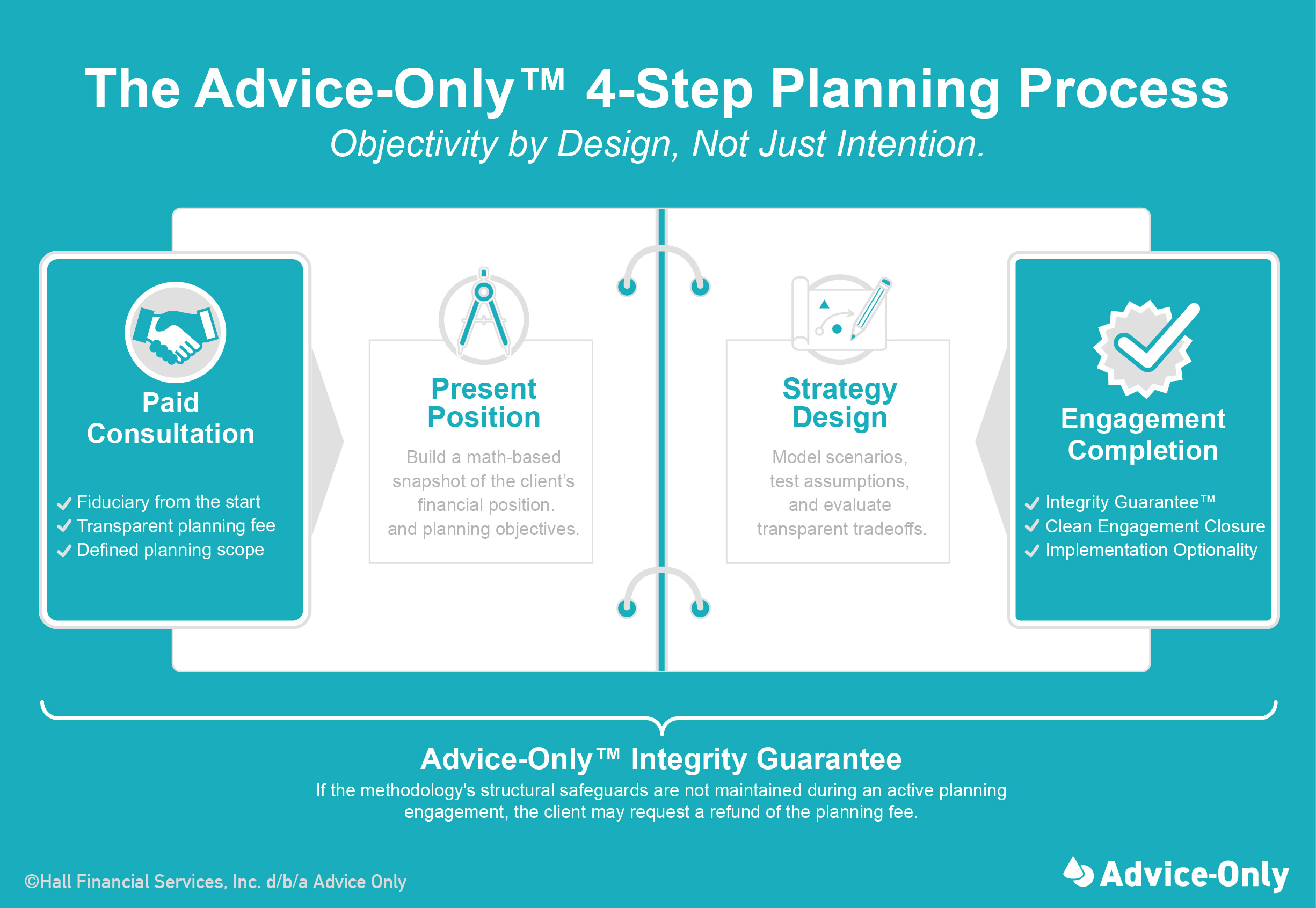
The Advice-Only™ 4-Step Process
The methodology follows a standardized, repeatable process designed to reduce implementation-linked influence and produce a documented, client-controlled planning engagement. Each phase has a specific purpose and defined deliverables:
- Paid Consultation – Begin with a paid consultation and a formal advisory agreement to establish fiduciary duty from the start. We conduct a structural conflict screening so advice begins in a deconflicted environment—free from sales incentives, asset minimums, or economic qualification thresholds.
- Present Position – Build a math-based snapshot of your financial life using the Advice-Only™ 40-Point Framework™. This creates an objective, data-driven baseline of your assets, liabilities, cash flow, and tax exposure before any strategies are evaluated.
- Strategy Design – Integrate your entire financial picture using Total Risk℠ Alignment. We model scenarios, test assumptions, and evaluate transparent tradeoffs across tax, investment, and income planning to finalize your strategy.
- Engagement Completion – The planning engagement formally concludes at the Engagement Completion Boundary once the plan and recommendations are delivered. This structural endpoint preserves Implementation Neutrality by maintaining a clear separation between financial advice and its implementation.
Optional Post-Engagement Support
After the engagement concludes, you retain full Implementation Optionality.
Because advice and execution are separated in time, you may implement recommendations independently, work with any advisor or custodian you choose, or initiate a separate agreement for additional assistance.
Any services provided after the planning engagement are client-initiated, governed by a separate agreement, and remain outside the Advice-Only™ planning process.
Verifying an Advice-Only™ Engagement
Because Advice-Only™ is defined at the engagement level, a completed financial-planning engagement may be assessed against the published methodology using documentary evidence.
Advice-Only™ verification examines whether the advice was formed, delivered, and economically completed before implementation-linked incentives could influence the recommendations. The assessment applies to the specific documented engagement—not to the advisor or firm generally.
How the Methodology Applies the Formal Definition
The formal definition of Advice-Only™ is applied through a governed, repeatable planning process and may be evaluated through the published Advice-Only™ verification architecture. The methodology does not rely on pricing alone. It uses structural safeguards to separate advice formation from implementation-linked incentives before recommendations are delivered.
Every Advice-Only™ engagement follows the same structural principles, so clients receive a transparent planning process designed to preserve objectivity, documentation, and client control.
The engagement is economically complete when advice is delivered. That means the advisor’s compensation for the Advice-Only™ planning engagement does not depend on product sales, asset management, referrals, custody, or any other implementation-linked outcome.
Core Principles of the Advice-Only™ Methodology
-
- Structural Separation
No custody, execution, asset management, referral compensation, or platform-linked revenue may occur within the planning engagement. - Transparent, Client-Defined Fees
All costs are established in writing before any advice. Fiduciary duty begins at the paid consultation. - No Asset Minimums
Open to everyone, ensuring equal access to high-quality fiduciary planning. - Accountability & Repeatability
A documented workflow supports transparency, quality control, and compliance. - Privacy-First Handling
Client inputs are confidential.
- Structural Separation
Origins of the Advice-Only™ Methodology
Launched in 2019 after observing persistent conflicts in advisory models that can still expose advice to implementation incentives, the Advice-Only™ approach was designed to exclude implementation-linked incentives from the planning engagement and make fiduciary-quality planning more accessible.
AdviceOnly® Education offers educational resources, methodology materials, and client assessments designed to expand financial literacy and support transparent planning decisions.
Why Clients and Advisors Choose the Advice-Only™ Methodology
- ✅ No Sales or Product Pitches — The engagement is structured to exclude implementation-linked incentives that could influence recommendations.
- ✅ Structurally Independent Billing — Pricing is disclosed in advance and never tied to what the client implements.
- ✅ Client-Centered Process — Personalized, educational, and actionable.
- ✅ Privacy & Accountability — Clear structural separation between financial advice, implementation-linked incentives, and client data use.
- ✅ Repeatable Results — A consistent, documented workflow for every client.
Learn More
Whether you are seeking structurally separated financial guidance, studying the methodology as a professional, or evaluating whether a documented engagement conformed, AdviceOnly.info provides the governing definitions, standards, verification materials, planning resources, and educational tools supporting the Advice-Only™ Methodology.
Review the Advice-Only™ Governance or learn How to Verify an Advice-Only™ Financial Planning Engagement.
Explore our resources through AdviceOnly® Education or request a paid consultation through Advice Only Financial Advisors.
See About and FAQs for details.
FAQs
Is this the same as fee-only?
No. Fee-only describes a compensation model. Advice-Only™ describes how financial advice is structurally formed before implementation-linked incentives can influence recommendations.
Who is it for?
Anyone seeking fiduciary guidance delivered through a structurally separated planning process—free from implementation-linked incentives, asset-based qualification filters, and referral obligations.